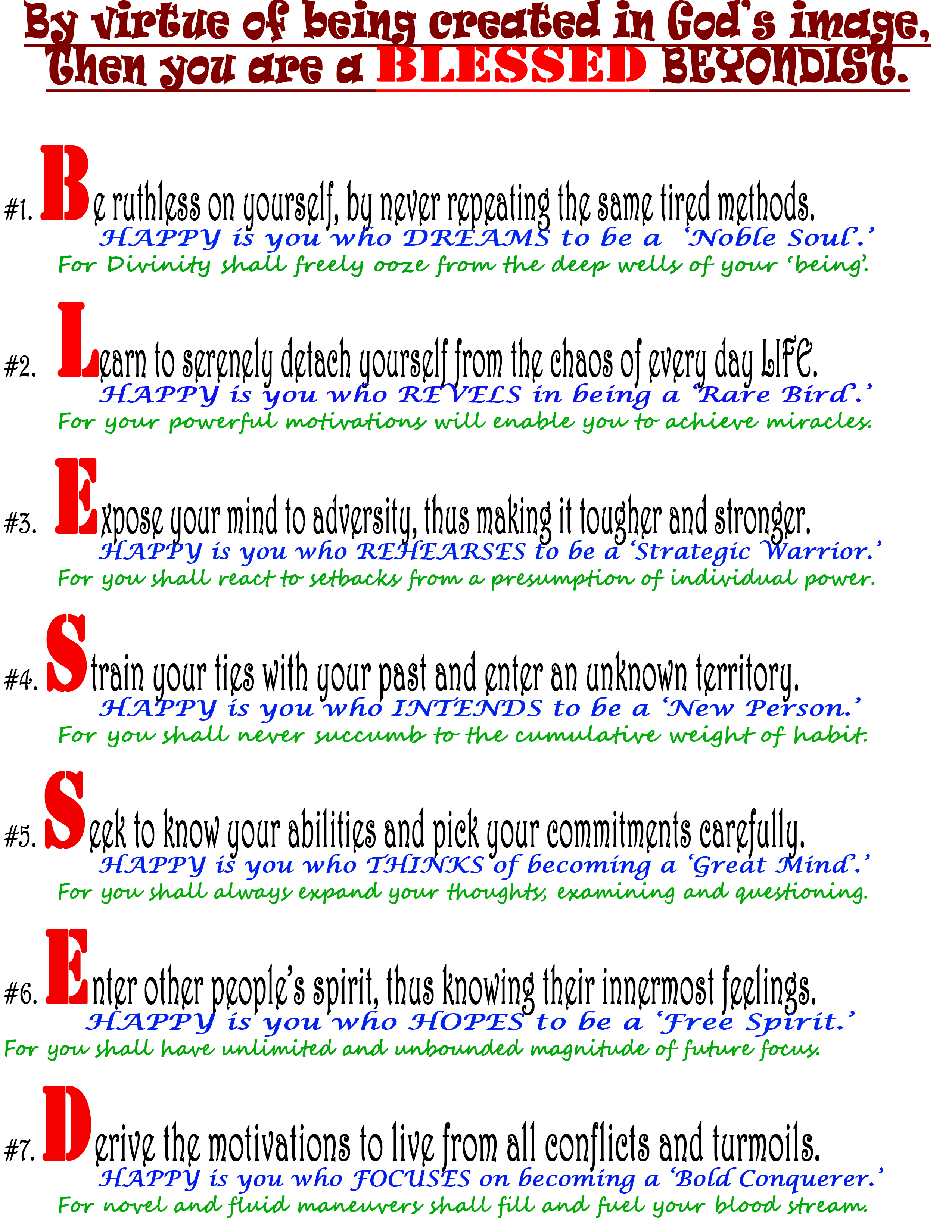
![]() May you merrily make the 4th MEANINGFUL MOVE! BEYONDISM affirms that, the normal personality is characterised by unity, integration, consistency, and coherence. A human being is basically good, not evil. He or she has the capacity to be an efficient, healthy and happy person. But he or she must nurture the capacity with awareness, honesty, introspection and maintain his or her freedom: to freely respond to internal and external events (values), to be him or herself at all costs. The knowledge that a person has this capacity motivates him or her to realise it. It also obliges him or her to actively work toward self-realisation. Personality problems generally results from the denial, frustration or twisting of our essential nature. Morality then is natural. If you use your capacity to think, are honest, sincere and open, you will arrive at moral and ethical behaviour naturally. The problem is to not destroy your ability to become your REAL SELF; to Activate your SELFHOOD. Here is an INSPIRING INSIGHT on the SEVEN criteria for MATURITY:BEYONDISM affirms that, the normal personality is characterised by unity, integration, consistency, and coherence. A human being is basically good, not evil. He or she has the capacity to be an efficient, healthy and happy person. But he or she must nurture the capacity with awareness, honesty, introspection and maintain his or her freedom: to freely respond to internal and external events (values), to be him or herself at all costs. The knowledge that a person has this capacity motivates him or her to realise it. It also obliges him or her to actively work toward self-realisation. Personality problems generally results from the denial, frustration or twisting of our essential nature. Morality then is natural. If you use your capacity to think, are honest, sincere and open, you will arrive at moral and ethical behaviour naturally. The problem is to not destroy your ability to become your REAL SELF; to Activate your SELFHOOD. Here is an INSPIRING INSIGHT on the SEVEN criteria for MATURITY:Implicit extension of the sense of self. Notable warm relating of self to other. Sound emotional security and stability. Intimate and realistic perception. Gainful understanding and humour. Holistic and unifying philosophy of LIFE. Trusting oneself and adaptability. Clouds come floating into your LIFE, no longer to carry rain or usher storm, but to add charming colour to your Sunset Sky. MATURITY is something that develops during Early Adulthood. BEYONDISM seeks to DULY DISTILL SEVEN psychological characteristics: What is Enlightenment? Enlightenment is man’s leaving his self-caused immaturity. Immaturity is the incapacity to use one’s intelligence without the guidance of another. Such immaturity is self-caused if it is not caused by lack of intelligence, but by lack of determination and courage to use one’s intelligence without being guided by another…Through laziness and cowardice a large part of mankind, even after nature has freed them from alien guidance, gladly remain immature. It is because of laziness and cowardice that it is so easy for others to usurp the role of guardians. It is so comfortable to be a minor! If I have a book which provides meaning for me, a pastor who has conscience for me, a doctor who will judge my diet for me and so on, then I do not need to exert myself. I do not have any need to think; if I can pay, others will take over the tedious job for me. The guardians who have kindly undertaken the supervision will see to it that by far the largest part of mankind, including the entire ‘beautiful sex,’ should consider the step into maturity, not only as difficult but as very dangerous. Statutes and formulas, these mechanical tools of a serviceable use, or rather misuse, of his natural faculties, are the ankle-chains of a continuous immaturity. Whoever threw it off would make an uncertain jump over the smallest trench because he is not accustomed to such free movement. Therefore there are only a few who have pursued a firm path by their own cultivation of mind. Maturity is a gradual and accumulative process that is not tied to a specific chronological age. It entails constantly becoming better able to cope with the decisions, tasks, and problems of LIFE. At the bottom it means freedom from one’s past and changing in pursuit of greater human values. In this regard, it is important that we differentiate between physical ‘Maturity’ and psychological ‘Maturity’.
|
May you reverentially receive the 4th LUMINOUS LIGHTNING!
|
[prompt 1...Left hand palm placed on the chest, Right hand raised with a clenched fist rending the air] Hail BEYONDISM!===>[reply 1...imitating the prompter, but rending the air 3 times] Awakened. Blooming. Creative....... [prompt 2...Left hand clinching the waist, Right hand palm stroking the chest] I AM a Blessed Beyondist (BB)===>[reply 2...imitating the prompter, but stroking the chest 3 times] Which amounts to being The Anointed One (TAO).......[prompt 3...Hands resting on the belly, head slightly bowed] In as much as My ‘BEING’ is in holy harmony with Nature and The SUPREME BEING so WHAT?===>[reply 3...imitating the prompter, but bowing the head 3 times] GOD IS FOR ME. GOD IS IN ME. GOD IS WITH ME. [facing each other, hands lifted up with open palm, slashing the air 7 times] AFRICA. AFRICA. AFRICA! ARISE. ADVANCE. ACHIEVE! AMEN! May you celestially celebrate the 4th BEYONDIST BOMBSHELL!
|
|
|---|
![]() “The possession of Knowledge, unless accompanied by a manifestation and expression in Action, is like the hoarding of precious metals—a vain and foolish thing. Knowledge, like Wealth, is intended for Use. The Law of Use is Universal, and he who violates it suffers by reason of his conflict with natural forces.” ![]() |
|
|---|---|
![]() May you gainfully get the 4th ILLIMITABLE INSPIRATION!
|
![]() |
|
Biography
|
THOU SHALL BE AUDACIOUS TO ALLOW THE FLOWERING OF GENIUS--->THOU SHALL BE AUDACIOUS TO ALLOW THE FLOWERING OF GENIUSWill-to-Selfhood Selfhood Code Sun Awakening Will-to-Strength Strength Code Mercury Success Will-to-Love Loving Code Venus Intimacy Will-to-Live Living Code Earth Progress Will-to-Health Health Code Mars Conquest Will-to-Lead Leading Code Jupiter Greatness Will-to-Relate Relating Code Saturn Goodwill Will-to-Parent Parenting Code Uranus Nurturing Will-to-Become Becoming Code Neptune Growth |
|
A
u
d
e
n
t
e
s
_
f
e
r
t
u
n
a
_
e
u
v
a
t
(Latin: “Fortune favours the bold”)
May you whoopingly win the 4th PURPOSIVE PRIZE! To be MATURE is what we SHOULD and MUST. ‘Maturity’ implies reacting well and flexibly to reversals, discouragements and failures. To guiltlessly laugh at ourselves when we stumble and make mid-course corrections. It is admitting mistakes made and initiating a reverse-course to remedy them. In this uncertain world, the rate of our ‘Maturity’ is directly proportion, To our resistance and our capacity to endure uncertainty. To deal with shortcomings by believing that we can achieve our objectives. This is through learning what we need along the way. As the backbone of ‘Maturity’ is goal setting, what does this imply? It is focusing of the will to move in a certain direction. Invest in the hours, give up lots of other things in LIFE and engage in hard, mind-bending work. First begin with a clear conception of what we want; putting them into words clarifies them. Rather than concentrating on material objects to acquire and possess, focus on fulfilling desires. To do and to produce all what yields to a true sense of satisfaction. It is advisable to visualise ourselves accomplishing that goal. While losers visualise the penalties of failure, winners visualise rewards of success. |
|---|
iv. “It is better to give than to receive”. The 4th AFRICAN AFFIRMATION: |
iv. “If you obey the disbelievers, they will make you turn on your heels so as to be among the losers”. The 4th SCRIPTURAL STANDING: |
|
“The beauty of life is to make it last for the better. Cuz nothing lasts forever.” ![]() |
|---|
May you felicitously face the 4th phase of DILIGENT DIMENSIONS |
In conjunction with BEING, the question what is MAN? has always been a relevant question till date and numerous responses have been given. Etymologically the word MAN originated from the Greek word anthropos which literally means “human being” something that is living. Heidegger etymologically defined MAN as an ‘animal rationale’ something living with reason. In this our epoch MAN is presented to us under very fascinating, effective categories, yet, we cannot say that the reality of the human being has become in anyway clearer. German philosopher Friedrich Nietzsche (1844 - 1900) considers the human person as a ‘will to power’ while Aristotle describes him as a ‘rational being’ and a ‘political animal’. Heidegger, in turn represents him as a ‘symbolic being’ just as German philosopher Ernst Alfred Cassirer (1874 – 1945) calls him an ‘alienated essence’. |
By Scrolling Up or Down, position the SECTION below to be at the center of the screen you are facing right now. Upon Hovering, the SECTION will expand; you can (while inside ) Scroll Vertically or Scroll/Snap Horizontally. You may continue with the pattern in the 5th phase of DILIGENT DIMENSIONS (or simply flow in this PAGE). |
|
i. Inside your folly a GENIUS is waiting to come out.ii. Understand, VALUE and develop your PSYCHE.iii. Be willing to take RISKS or leaps of faith.iv. Aspire to be CREATIVE, to manifest competence.v. Be open to CHANGE when the situation calls for it.vi. Find ways to ACCOMONDATE what is new and different.vii. Keep a part of the old that is useful; discard what is not.Truly, this is your 4th Mortal Mission, as a function of your Divine Duty. |
May you intimately immerse in the 4th THERAPEUTIC TRANSCENDENCE |
Why is BEYONDISM effortlessly ECLECTIC, without being effetely ENIGMATIC? Here is the 4th DIVINE DOSE to keenly keep your PSYCHE bounteously BOOSTED: BEYONDISM honors ancestors and others— Aquinas, Buber—each SOUL adds depth and dimension. |
| Our 4th Therapeutic Transcendence rolls out as spiced by Three Philosophers and Three Psychologists. |
| See below how the ideas of these icons fuse in, in laying down a new African dispensation. (To conveniently rotate the 3D Cube below, mouseClick left inside, hold, drag abit and then release. Consequently, move the mouse in your desired XYZ direction; to stop double-click left again.) |
![]() ![]() ![]() ![]() ![]() ![]() |
|
|
The 4th ONE Word (hover below) which Breeds SEVEN Words to Depict Who a BLESSED BEYONDIST Is:---> The 4th of SEVEN reasons why you should be PROUD to be an AFRICAN:
|
BEYONDIST Text to Speech ConverterHail Assertive African, click here to listen to what you have affirmatively ascribed unto thyself Because the brain’s selective filtering system, often referred to as PRIMING, works on an activation/inhibition model, when the brain is primed by a certain BELIEF to look for something, it shuts down competing neural networks, so you actually have a hard time seeing evidence to the contrary of an already existing BELIEF. That is why people who are depressed see a more depressing world. It is also why you are so convinced that your view of the world is the “TRUTH.” What most people do not realize is they are participating in creating their own version of the TRUTH. O Thee Blessed Beyondist, stop mark-timing in your low self-esteem. Seize this historical chance and merry moment to soulfully scribe for yourself a unique ‘Individually Inspiring Instruction’. ---> |
Born on March 25, 1987, American Jason René Castro,JASON CASTRO - Only A Mountain Is a very successful acoustic folk-pop and a rock-star. He is also a contemporary Christian singer-songwriter. His ‘Only a Mountain’ released in 2012, is so inspiring . You don’t have to find your way around this mountain. Just tell it to move, it’ll move, and tell it to fall, it’ll fall. Take your fear and say there’s nothing in your way..... Another day, another fight This is only a mountain You don’t have to find your way around it Tell it to move, it’ll move Tell it to fall, it’ll fall This is only a moment You don’t have to let your fear control it Tell it to move, it’ll move Tell it to fall, it’ll fall Ask like you believe it Trust like you can see it Take your fear and say There’s nothing in your way, no oh Even when it looks big Even when you feel small Just a little bit of faith can change it all This is only a mountain You don’t have to find your way around it Tell it to move, it’ll move Tell it to fall, it’ll fall This is only a moment You don’t have to let your fear control it Tell it to move, it’ll move Tell it to fall, it’ll fall It’s only a mountain It’s only a mountain Just a little bit of faith can change it all Hey Hey Hey It’s only a mountain Just a little bit of faith can change it all It’s only a mountain |
| To listen to the music, click PLAY icon below. To see the content of the music, hover above. To sychronize the music and content, hover in or out on the marquee content for pausing or moving. |
It was U.S. writer and journalist Ambrose Bierce (1842 - 1914?) who humouristically defines Childhood as: “The period of human life intermediate between the idiocy of infancy and the folly of youth — two removes from the sin of manhood and three from the remorse of age.” “All the joy, all the uncertainties, and all the solitude of childhood suddenly came back to me with that, the unmistakable flavor of the hams my grandmother made,” so wrote Colombian novelist Gabriel García Márquez (1928 - ). God has saved you a lot of shame for making you unable to remember when you were an infant. But, upon some critical triggers, you may remember with a little amusement the time when you were about six years old, and when you were unable to begin at the end of an operation and get back to the start. For example, you could use the information 5 + 2 = 7, but fail to figure out the answer to the 7 – 2 = ______. Listen to U.S. poet Edna St. Vincent Millay (1892 - 1950): “Childhood is the kingdom where nobody dies. Nobody that matters, that is.” You may also laugh at yourself upon remembering, KITENDAWILI! |
Pointlessly gave cause-effect relationships to events, which were not related.---> This is overgeneralizing the connection between one known specific event and overassuming that casuality was related to the closeness of events. |
Unwittingly attributed real physical properties to mental phenomena.---> This childish realism led you to believe that thinking about hurting someone was actually hurting someone. |
Essentially believed that inanimate objects had a consciousness and were alive.---> This animism led you to believe that a lost item was hiding or that the sidewalk deliberately tripped you when you fell. You may have hit a chair for getting your way or scolded the shoe lace for becoming untied. |
Randomly believed that human beings caused natural phenomena.---> This belief in artificialism may have resulted in asking your parents to stop the rain for a picnic or to turn down the volume of thunder. |
Indeed, you had trouble in understanding transformations, the transitions from one another.---> You could usually point out the beginnings and ends of events but unable to understand and remember the sequence in-between. |
Lacked three-dimensional thinking. You paid attention to only one dimension at a time.---> For example, in the conservation of volume task, you failed to realise that the different-shaped glasses contained the same amount of beverage. You paid attention to only one dimension of time (height) and unable to consider the three dimensions needed to comprehend volume. |
Egocentrism made it difficult for you to understand another’s point of view.---> This is the belief that other people experience environment identical to you, and that the world revolves around you. |
“As the roaring of the waves precedes the tempest, so the murmur of passions announces the tumultuous changes…” BEYONDISM prudently proposes that being accused of behaving like an TEENAGER, |
Adolescents experience the most intensive and extensive changes in biology since birth.---> During this time, there is a growth spurt, characterised by a sharp increase in height and weight. The changes in physical appearance are accompanied by a remarkable change in the body’s physical exertion. |
Substantially, this stage is characterised by ability to deal with abstract things or concepts ---> without visible representations. In contrast to the former years of late childhood, one is now capable of systematic, logical and analytical approaches in dealing with problem situations. |
Positively developing one’s self-concept and a sense of identity, is vital. The capacity---> to think about oneself and question things becomes very necessary. One often want to know the reasoning behind decisions made; which may bring one into conflict with authority. |
Entrenching oneself fully at this stage, entails refighting many battles one had earlier won---> in one’s earlier years by forging for oneself some cultural perspective and direction, some working unity out of the effective remnants of one’s childhood and one’s anticipated adulthood. |
Critically, the big test is on one’s ego’s accumulated capacities to integrate talents, aptitudes,---> and skills, to identify with like-minded people and with other’s impression of oneself, and to begin to make vocational choices. |
Thouroughly immersing oneself in the psychosocial prerogatives of this stage, forms the basis---> for one’s sense of destiny. In this way one is able to form Ego Identity, which results in a sense of coherent individuality that enables one to resolve one’s conflicts adaptively. |
Satisfactorily answering the question, ‘Who am I?’ is a MUST. Failure to do so, one suffers---> Role Confusion; the inability to conceive oneself as a productive member of one’s society, by failing to find an occupational identity as well as a meaningful place in one’s culture. |
“What is an adult? A child blown up by age.” - French writer and feminist theorist Simone de Beauvoir (1908 - 1986) “Men come of age at sixty, women at fifteen.” - Irish novelist and poet James Stephens (1882 - 1950) “An adult is one who has ceased to grow vertically but not horizontally.” - Anonymous In the spirit of adventure and discovery, |
Intimately understand that transformations do not affect physical attribute ---> of the object e.g. dough rolled in flat like a bread only changes the form, but weight and mass does not change. |
Negating shallowness, by getting BEYOND one main characteristic---> of a situation and considering many aspects at once. This entails being able to compare an event with its broader context. |
Incorporate diverse views, and look for physical causes of events, ---> to establish rules to guide behaviour, and to expand your spatial awareness and time consciousness.This entails realising like Spanish novelist and dramatist Miguel de Cervantes (1547 - 1616): “Never look for birds of this year in the nests of the last.” |
Telling the bitter TRUTH laughingly, or teaching the hard FACTS, softly. ---> Use of humour to help reinterpret situations and to help control such emotions as anger, anxiety and depression. Humorous jokes are those that provide moderate amount of intellectual challenge. |
Indulge in developing the ability to judge behaviours more in terms ---> of intentions rather than merely by consequences. This is what informs the cardinal maxim of the criminal law, ‘actus non facit reum nisi mens sit rea’, which means ‘the doing of an act does not make a man guilty unless he has a guilty mind’. |
Accept that your own thoughts and feelings are not necessarily shared ---> by others and may reflect personal opinions other than reality. As a result, you know that, you can sometimes be wrong and thus begin to seek out external validation for your ideas. |
Leaning towards the cultivation of the ability to view situations from others’---> point of view and know that a variety of possible viewpoints exist. This waters down any dogmatic tendencies, and lays the basis for tolerance as well as a democratic disposition. |
Elegance is the only beauty that never fades.
As you continue cherishing and nourishing love with wisdom, you shall be able to deepen your devotion with sacrifice. In the end, you shall merrily sing like English Poet Percy Bysshe Shelley (1792 - 1822): Life may change, but it may fly not; “Instead of dirt and poison we have rather chosen to fill our hives with honey and wax; thus furnishing mankind with the two noblest of things, which are sweetness and light,” so proclaimed Anglo-Irish writer and clergyman Jonathan Swift (1667 - 1745). English poet and playwright William Shakespeare (1564 - 1616), in Sonnet 17, depicted elegance thus: If I could write the beauty of your eyes |
IT IS ‘PARTICULARLY PRETTY PERTINENT’ to note that myriad militating factors and belligerent barriers are evident in the general fabric of our African society. Prevalent as they are, they may also have affected each one of us to a certain degree, either directly or indirectly, implicitly or explicitly. More regrettable and viciously appalling, is this state-of-affairs made, if we take into consideration the fact that, a reasonable number of our YOUTHS are confused, naïve, helplessly battered by cruel forces that crush their dreams before they are even born. These youngsters are consequently seized by a strong feeling of marginality, not belonging, a widespread feeling of inferiority and of personal unworthiness. Our society has become achievement-oriented, stressing the goal of success as an end in itself almost but of course, not entirely irrespective of the means employed. In this virtual darkness, living our lives somewhere along a wide curve of deep-rooted, bottle-up inexpressible anger, the smell of adour of decay is almost everywhere. South African poet Daniel Peter Kunene in Pirates Have Become Our Kings (1968) captures this point vividly: War is |
“Thou cam’st on earth to make the earth my hell.
|
Considerably, the world is awfully harsh at the very outset.---> Happiness is a delusion outside mortal reach; it is merely impossible to attain any refreshing amout of joy under the prevailing circumstances. |
Assailed by misfortunes and calamities from all corners---> and directions, it is apparent that little can be achieved in a society where everything is unforeseeable and utterly unpredictable. |
Perceived from all possible angles, LIFE has little MEANING---> and has nothing important to offer. So far as things are, nothing matters very much, and very few things matters at all, and whatever seems to matter cannot be trusted or relied upon. |
The society is indifferent to my needs. Whatever I try is---> condemned to fail, and all my efforts are exercises in futility. All in all, individual aims in LIFE fade away instead of being realised. |
I am a fated stranger to LIFE. I do not feel as if I am entitled---> to enjoy the GOOD THINGS of this world. There is no one to rely on for moral and social support when in dire need, or even whenever I am in trouble. |
Very few chances to make any substantial breakthorough in the---> society exist. Therefore, I should greedily take what I can today, because tomorrow there will be no available opportunity. |
Every avenue for my diligent and prudent efforts to be duly---> rewarded, is either closed or very narrow. As such, it basically takes dishonesty, duplicity and deceit to succeed instead of hard work and competence. |
‘NULLIFYING NIHILISM’ is not an incident, it is not an accident, it is not a temporary aberration, but the logical consequence of bottled up emotion of ‘future hopes strangled’. “If you want to converse with me” cautioned French writer and philosopher Voltaire (1694 - 1778), “define your terms”. So before we make any further motion, it is important that we come out clear on what we mean by NIHILISM. Having found themselves in such a catastrophic mode of personal perception, the victims reacts in different ways which depend so it would seem reasonable to infer, upon their ‘personality predispositions’ and partly upon the ‘specific social situation’. Suffering shockingly shattering stress, the most appropriate phrase to explain the end result of such a state of mind is ‘an unprecedented flight towards Nullifying Nihilism’.---> |
The word NIHILISM can etymologically be traced from the 19th Century German word Nihilismus, as derived from Latin word Nihil, which means ‘nothing’. The term NIHILISM was first used to describe Christian heretics during the Middle Ages (a period in the history of Europe that lasted from about AD 350 to about 1450). In the academic circles, the word NIHILISM was in fact used as early as 1799 in the letter of the German philosopher Friedrich Heinrich Jacobi (1743 - 1819) to his colleague German philosopher and educator Johann Gottlieb Fichte (1762 - 1814): “My dear Fichte, I really shall not be put out if you or anyone else want to call Chimerism that which I am opposing to Idealism, to what I prefer to call Nihilism”. The word Chimera implies something merely imagined, at bottom as nothingness. What therefore, does NIHILISM mean? Ask German philosopher and philologist Friendriche Nietzsche (1844 - 1900) here, and his answer flows: “That the highest values devaluate themselves. The aim is lacking; ‘why?’ finds no answer….Radical nihilism is the conviction of an absolute untenability of existence when it comes to the highest values one recognises; plus the realisation that we lack the least right to posit a BEYOND or an in-itself of things that might be divine or morally incarnate”. This explains why Russian NIHILISTS were considered would be murderers, one and all-assassins by premeditation, if not by deed; a people who did not know what they wanted, but were perfectly ready at all times to commit any sort and number of hideous crimes. In an interview with British foreign correspondent William Beatty-Kingston in 1890, Prusso-German statesman Prince Otto von Bismarck (1815 - 1898) known as the iron Chancellor for the strength of his leadership, depicted Russian Nihilism thus: Overeducation in countries like Germany leads to much disappointment and dissatisfaction; in Russia, to disaffection and conspiracy. Ten times as many young people are educated there for the higher walks of LIFE than are places to give, or opportunities for them, in the liberal professions, to earn a decent living, far less wealth and distinction. There are too many free scholarships and presentations by half, by appointments to which poor people’s children are taught to be unhappy and useless. Perhaps it is not quiet the right kind of learning, too. Priest’s children, for instance, most get their high school and university education for nothing. What good does it do to them? When they have gone through it, in nine cases out ten there is nothing for them to do, and their learning is worse than a superficiality to them, for it make them discontented and miserable. They are painfully prepared to compete for greater prizes than life really offers save to a very few, who rarely spring from their class. I have come across street watchmen who had studied in universities, and taken bachelor’s degrees. Could anything be more cruel, as well as absurd? Such people filled with envy and hatred of all that is prosperous and high placed, readily takes to conspiracy and crime. They are not fit to construct, but knew just enough to qualify them for destroying. It becomes much easier to damage than to redeem; so they do evil and calls it redemption. |
A definition is a statement that is true, because of the way in which we have agreed to use words. Stipulative typical NIHILISM in our African society, can be construed to be either ‘Nullifying’ or ‘Nourishing’. It is ‘Nullifying’, in as far as it reflects our succumbing to the seemingly heavy yoke and oppressive burdens of existence, thus prompting us to say ‘NO’ to LIFE in all its illuminations. It is ‘Nourishing’, only to the extent which it propels one to say ‘NO’, in the manner of annihilating and repudiating all negative LIFE attitudes and aspects, and in its place assert an absolute positive affirmation of LIFE.---> “Nothing in the world matters; not even success in America but just void and emptiness await the career of a soul of a man,” so proclaimed U.S. writer Jack Kerouac (1922 - 1969). Algerian-born French novelist, essayist, and dramatist Albert Camus (1913 - 1960) had the audacity (or pessimism?) to script these words: “One cannot be a part-time nihilist...I proclaim that I believe in nothing and that everything is absurd, but I cannot doubt the validity of my own proclamation and I am compelled to believe, at least, in my own protest. The first and only datum...within absurdist experience, is rebellion.” Perhaps Camus did not have the luck to see these words (or simply ignored them?) of German philosopher and poet Friedrich Wilhelm Nietzsche (1844 - 1900): “What I am doing is to recount the history of the next two centuries. I am describing what is coming, what can no longer come in any other form: the rise of nihilism.” Still in this most critical matter, Chinese journalist Wang Ruoshui (1926 - 2002) had a pondable point: A specter haunts the intellectual world. |
In his book Beyond Freedom and Dignity (1971), American psychologist Burrhus Frederic Skinner (1904 - 1990) asserted: “Survival is the only value according to which a culture is eventually to be judged”. Skinner argued that, a human being is nothing more than an organism, a bundle of behaviour shaped by his or her environment; that during evolution the environment shaped the behaviour that survives in our genes; that after birth, environmental conditioning shapes each one of us in this LIFE. American psychologist and educator Edward Lee Thorndike (1874 - 1949) had formulated ‘the law of effect’, which states that when a behaviour or a performance is accompanied by satisfaction, it tends to be stamped in and increased; if accompanied by frustrations, it tends to decrease. Following this line of thought, Skinner viewed ‘reinforcement’ as anything that increases or decreases the likelihood of a response, and that it is the effect of one’s behaviour that determines the likelihood of its occurring again.
|
Situationally, frustration is an emotion which occurs when one is unable to satisfy a drive, because the response that would satisfy it is blocked. It arises when our need for a stable thought system, by which to organise--->
|
Essentially, when there is a lack of coherent connection between a shattered present and an uncertain future, any truly creative activity is ruled out, as well as any possibility of self- assertion. As long as it is impossible --->
|
REVENGE is the domineering instinct which arises as a means of enduring LIFE, and as a self-preservative measure. It is at bottom an attempt at justifying one’s lack of power and self-confidence. Out of the--->
|
Instinct of the denial of LIFE, is the prevalence of ‘Nullifying Nihilism’ at its extremity. This points towards a total decadence of value judgements, leading to the conviction of the futility and worthlessness of reality. --->
|
Occupationally, when our youths are bound in a confusion which it seems impossible to fix, and against which it seems merely foolish to protest, a vague taste of sorrow prevails. This throws them into a condemnation---> of asking questions that are never new to them, but to which they have no hope of finding any answer. Anytime they contemplate a way out of the present rottenness, or a bright future, a silent sound of ‘NO’ eats into their minds in every spiral and stays there circling in tightening rings, never letting go. In their warped, ailing and bleeding consciousness, the world seems not here, not present with its terrible closeness, but something outside. It is such a strong and primitive thought, that there is nothing in loneliness but pain. The victims are trapped in the vicious cycle of desperation which was outlined by Scottish historian and philosopher David Hume (1711 - 1776) in this manner: “Grief and disappointment give rise to anger, anger to envy, envy to malice, and malice to grief again, till the whole circle be completed”. |
Undermined and defeated in most aspects of LIFE, ‘Nullifying Nihilists’ are bewildered souls who perceive themselves as social outcasts. They are caught in the whirlpool of mourning an inhospitable earth and --->
|
Sad and lost, as the victims are gripped in search for a belief system which can explain the horror of their lives, their answer finds itself in the simple word, ‘NO’. A ‘NO’ which is an imaginary revenge of refusing the---> society that had initially refused them. It is a ‘NO’ which is frequently the voice of revenge, and only defeated warriors can contribute to it; and when any person invokes it, it is his or her wounds that speaks. At the extremity, they will say ‘NO’ to everybody and everything; ‘NO’ to every order and probably ‘NO’ to every request and every plea. As the negativism of the toddler whose favourite word is ‘no’, is evidence of the child’s struggling attempt at autonomy, Nullifying Nihilistic ‘NO’, tends to give temporary empowerment to the powerless. ‘NO’, tends to imaginary deny the dominion of the strong over the weak. ‘NO’, may serve as the opium which eases the minds of the tortured, the traumatised and the guild-ridden. ‘NO’, is the illusory hope that what came before will never be again. |
Majority of our societal members are in desperate peril; without a productive, fulfilling and creative LIFE we will lose the spiritual equivalent of oxygen. A good number of them laments like English playwright Philip Massinger (1583 - 1640): “Sometimes virtual crimes lie dormant, and operas are stored away in a maestro’s head, only to await the creative influence of genius to inspire their opening bars,” so said Brazilian novelist and short-story writer Joaquim Maria Machado de Assis (1839 - 1908). The dominant thread of ‘Nullifying Nihilism’ is what Nietzsche referred to as: “The hatred of egoism. Whether it be one’s own, or another’s”. The worst offshoot of ‘Nullifying Nihilism’, is that the victims get attracted to, or lured by ‘Catchy Cultism’, or find refuge for the expression of their perverted and bottled up instincts in ‘Gnawing Gangsterism’.---> |
Let us narrow down on ‘Catchy Cultism’. First, it is extremely important that, we note the remarkable difference between ‘Sects’ and ‘Cults’; words which are seemingly related and often confused for each other. If we focus on the ‘Sects’, it becomes undeniable that, their emergence is precipitated by the inability of their adherents to fit in the voluptuous consumption ethic of other members of society, or the mainstream churches. They consciously or unconsciously establish themselves as the refugee of the poor and marginalised. This explains why, as their members rise in the economic scale, they begin to compromise their original world-renouncing ethics, whereas those left behind in social struggle, draw apart into separate and congenial groupings. It is such folks who continue to constitute the main support of contemporary ‘Sects’. The particular and distinctive trait of ‘Sects’ is that, having never been able to succeed in the world, they take revenge by speaking ill of it. After resigning themselves to some weird, humanitarian illusion, they develop a distinctive code of ethics, which is a corollary of its worldly estate. It is a legalistic, rigid, puritan, black-and-white morality which divides men and women all too easily into world-affirming goats and world-renouncing sheep, or, in other words, into children of darkness and children of light. The vices are merely the practices of the opulent, whereas abstinence and mortification of the flesh are the moral foundations of their code. They despise all ostentation and all literature, art and music, that is not propaganda for their particular tenets as wholly mundane or as ‘spiritual pornography’. Listen to prominent American Professor of Comparative Religion Horton Davies in Christian Deviations – The Challenge of New Spiritual Movements (1965): As the comfortable members of the historic churches find emotional outlets in cultural associations and social recreations usually outside the churches, for the sectarians, however, religious community provides the whole of their LIFE. Indeed, the sectarians deliberately adopt devices to stir up the emotions and, with complete sincerity, they attribute the results to the direct activity of God, the Holy Spirit. |
In The Road to Total Freedom: A Sociological Analysis of Scientology (1976), American Religious philosopher Roy Wallis (1945 - 1990), argues that a ‘sect’ is characterised by ‘epistemological authoritarianism’, whereby they possess some authoritative locus for the legitimate attribution of heresy. According to Wallis “sects lay a claim to possess unique and priveledged access to the truth or salvation and their committed adherents typically regard all those outside the confines of the collectivity as ‘in error’”. He contrasts this with a ‘cult’ that he described as characterised by ‘epistemological individualism’ by which he means that the ‘cult’ has no clear locus of final authority beyond the individual member. If you want to be a slave in LIFE, then continue going around asking others to do for you. |
Affirmatively, ‘Sects’ are products of religious schism (a term which means any formal and willful separation from the unity of the Christian church and unlike heresy, with which it is often linked, it does not of itself---> denote doctrinal deviations) and therefore maintain a continuity with traditional beliefs and practices. ‘Cults’ on the other hand are groups of movements propelled by a tendency to resist the discipline of real religious or social practices, opting for mere fascination with extra ordinary phenomena. A ‘Cult’ arises spontaneously around vague beliefs and systems of ritual practices with the exhibition of a great or excessive devotion or dedication to some person, idea or thing. A ‘Cult’ centers on sacred symbols, as manifested by a body of admirers, and often employs unethically manipulative techniques of persuasion and authoritarian control. |
Notably, whereas ‘Sects’ exists in tension with the church that they defected from, ‘Cults’ by engaging in boundary-maintaining practices and creeds exist in tension with the larger society. Whereas the ‘Cult’ --->
|
A vital characteristic of the ‘Cults’ is their craving for objectivity and authority. As they cannot bear the burden of facing the crude realities of the world, they find the black-and-white ethical code a respite from the---> responsibility of weighing motives and intentions. There is an unconscious tendency among the members to demand of their leaders that they give them certainties, since they have enough doubts of their own. Emotionally deprived as they are, they are fanatically devoted to their leader(s), who further exploit this state by further mind controlling and brain washing them, stripping them of their ability to act or think independently, by seeking control of every aspect of member’s lives and allowing no questioning of decisions. |
LIFE may at times seem valueless or meaningless. Whether one joins a group (a cult in this regard), because of how he or she views the group, or for fulfillment of subconscious psychological needs, or through--->
|
Yearning for a sense of belonging is a vital need in LIFE. On a deeper examination, the relationship between ‘Cult’ groups and the individual members who join them is appalling. Some form of coercive persuasion or ---> mind control is used to recruit and maintain members by suspending their individuality, besides suppressing their ability to reason, think critically and make choices in their own best interests. Upon recruitment and in a very subtle and indirect manner, members are put in physical or emotionally distressing situation, and their problems are reduced and narrowed down to one simple fantastic explanation, which is repeatedly emphasised. Having come from a perceived unlovely larger society, they are subjected to a kind of ‘love bombardment’, receiving unconditional love, acceptance and attention from charismatic leader or group, thus getting a new identity based on the group. |
Subjection to entrapment (isolation from friends, relatives and the mainstream culture), where their access to information is severely controlled, is another cultic strategy. Through debilitation, use of special methods ---> to heighten suggestibility and subservience, coupled with powerful group pressures, this promotes deep-seated dependency on the group and its leaders. This is solidified by the fear of extreme consequences of revealing the group’s secrets, besides desertion from the group. There are also constant use of ‘Breaking Sessions’ (which is used by members and cult leaders to attack on those who are suspected as not measuring to the expectations of the group, like recruiting others members). A person is verbally and emotionally attacked untill one to extreme case, cries uncontrollably. |
Effetely driven by the delusive conviction that, they alone are treading the right path, is the bitter necessity to condemn others outside their circles. This leads to the development of an acute ‘Them-Against-Us’---> mentality, that entrenches mass neurosis. The consequence of this is that, they unwittingly isolate themselves from the larger society – the larger society becomes virtual enemy. Members are constantly warned of engaging themselves in the affairs of the general society, in the guise of avoiding intoxicating themselves, with the implied societal rogue ways and ideals. Contact with others is restricted only to the purposes of recruitment, otherwise members are under strict orders to relate only with members of their cult. This sheds light on why they are disposed to say ‘NO’ from the very outset to what is ‘outside their circle’, ‘different from their circle’ and ‘not their circle’; and this ‘NO’ becomes their creative deed. |
Mass movements are a function of adaptation; its pulse is change. |
‘Cults’ are very good at imprisoning TRUTH through institutionalised system of beliefs and dogmas. With the mind imprisoned in superstition and fear, the individual personality gets crushed, and originality is suppressed. The individual lacks not only mechanical efficiency, but is denied that spiritual freedom which drives human beings to discovery and free movement. By encouraging ceremonies and practices that soon lose their original meaning and become mere routine, ‘Cults’ have discouraged their adherents from trying to understand not only the unknown, but also what might come in the way of individual’s social and intellectual effort. They have refused to allow their members to fall into that chaos of mind, and theory which prevail in the camps of the advanced intellectuals of our time. By discouraging curiosity and thought, and preaching the philosophy of submission, they tend to close and limit the minds of their members and to produce dependent, dislocated, unfree individuals. Allaying themselves to shadowy theology, ‘Cults’ produces narrowness and intolerance, credulity and superstition. This brings us to another devastating trait of ‘Cultism’ (though not restricted to cults but to other sects as well) which defies all theological fundamentals, in the manner of TERRIFIC THEOPRENEURSHIP. This is not a new phenomenon as it can be traced back to the 16th Century Church under Pope Leo X (1465 - 1521), the last non-priest (only a deacon) to be elected Pope (1513 - 1521). In his era, Papal Indulgences (a grant by the Pope of partial remission of time to be spent in purgatory or of some other consequences of a sin), were so popular that they were publicly sold not only for the living but also for the dead. To the ordinary folk, an Indulgence became almost an insurance policy against punishment for any sin, and repentance fell by the wayside. “Everywhere”, wrote Dutch writer, scholar, and humanist Desiderius Erasmus (1466 - 1536), “the remission of Purgatorial torment is sold; nor is it sold only, but forced upon those who refuse it”. One of the most popular Theopreneur of those early days, was John Tetzel (1465 - 1519), a Dominican friar, whose claims for the effect of Indulgences were exceptionally extreme and superstitious. “As soon as the gold in the casket rings; the rescued soul to heaven springs”, he said. |
In our modern times, the game has taken a notch higher though in a different dimension. Mushrooming of religious outfits, with fluid management structures and hideous characters at their helm, has made these deceitfully designed churches, to accrue profits that rival blue-chip companies. With sect or cult leaders - or call them pastors if you like – enjoying opulent lives at the expense of the flock, most of these modern day Theopreneurs are so creative and smart and persuasive in their oratory that, it seems even Tetzel is not fit to wipe off the dust in their jackboots. They spend a fortune running expensive promotion campaigns in the media, buying cutting edge ICT equipment and engage top gospel singer and DJ’s. ‘Terrific Theopreneurship’ has fantastic longings as its breeding ground, which finds their tap roots upon the oppressiveness of reality, where they also bloom. It is a notable assertion that in times of anxiety, scarcity and decline, as we are witnessing in our time, fantasies takes root in most people so powerfully because facing reality becomes so tormenting. In this situation, most people therefore, become simple preys to all sorts of charlatans and cons, who by spinning a fantasy or a quick fix solution out of an oppressive reality, promising a great and total change from poor to rich, misery to ecstasy, sickness to health, gains a good following. They further plung their captives into untold miseries, by turning them into objects of exploitation. It has become a norm to find gullible followers giving astronomical sums of money in the name of ‘planting a seed’, to these callow organisations calling themselves churches, headed by these ‘over-promisers’ and ‘under-delivers’. |
We are now on ‘Gnawing Gangsterism’. Our geneneral constitution as human beings – our bodies, our souls and our minds – owes much to Nature. We would therefore be in a better position, to assert that, the incompatibility, the lack of harmony with Nature excites derisions, which cannot be kept secret or repressed. Would the resultant effect, which is a consciousness of cruelty of Fate, incite the victims to acts of violence? French writer Gabriel Chevailler (1895 - 1969) in the novel Clochemerle (1936) strives to give the answer: There is something relentless about the serenity of nature which has a crushing effect on the human mind. The lavish splendour of her phases which completely ignores human strife fills the race of men with the sensation of their own ephemeral insignificance and drives them mad. Whilst vast masses of human beings are tearing each other to pieces in hatred, Nature, with sublime indifference sheds her brilliance over all these horrors and during the short breathing-spaces which the combatants allow themselves, by some evening of magic loveliness or morning of festive beauty reveals the absurdity of all this raging madness. But all that beauty, which should help to reconcile mankind, is expended to no purpose. Its only effect is to reconcile them to still greater energy in their ruthless activities, fearing that they may vanish in their sight and leave no trace, and unable to conceive any more impressive and lasting monument than wholesale destruction.---> “With us humans, primitive savagery lies close below the surface of our veneer of civilisation. When you get the chance of really losing your temper with an adversary and of being able to consummate it by killing him, it is a luxury unknown to those who have never indulged their evil inclinations”, so writes British soldier and founder of the Boy Scouts Robert Baden-Powell (1857 - 1941), in Lessons From The Varsity of LIFE (1933), in a rather extreme manner. However much we contend the potential possibility of every human being to be on the other side of law in one way or the other, when people team up in gangs or become part of a movement with a distinctive sub-culture of their own, they tend to view crime as a comparatively normal behaviour. But treason is not own’d when ‘tis descried; |
Through the organisation, formation, and establishment of an assemblage, sharing a common identity, a ‘Gang’ is basically a criminal organisation or else a criminal affiliation defining itself to be in opposition to mainstream norms - but at the same time deviously aspiring to be recognised by the same society. “Like art and politics, Gangsterism is a very important avenues into mainstream society”, thus commented American novelist Edgar Laurence Doctorow (1931 - ). “Heaven takes care that no man secures happiness by crime.” ---> |
Varieties notwithstanding, a gangster is a member of an organised gang of criminals, especially a racketeer. ‘Gangsterism’ entails aligning or subscribing onto an illegal or antisocial group which uses underhand,---> even terroristic methods to achieve their ends. Being products of social deprivation and alienation, members are sometimes bound by a rigid code of conduct that includes abhorring all contacts and cooperation with the authorities. They mostly engage in activities ranging from illicit liquour, to gambling, prostitution etc. Others engages in activities like extortionism, collecting protection fees, trading and smugglings in drugs and narcotics, arm trafficking, human trafficking, kidnappings for ransom, carjackings, armed robbery, illegal immigration, assault, pandering, financial crimes, money laundering and piracy. |
In the year 2011, the United Nations estimated that ‘Gangs’ made most of their money through the drugs trade, and they were thought to be worth US dollars 352 billions in total. ‘United States Department of Justice’ estimated ---> that there were approximately 30,000 gangs, with 760,000 members impacting 2,500 communities across the United States. ‘Gangsters’ are therefore, as dangerous to the society as they are lethal to themselves, for they may end up being typical killjoy and peace destroyers. Misled as they are by their megalomaniac ideal; always busy trying to hypostasise and deify their own guiding line, and to cross those of others, they are tightly held in the grip of a guilty past, hatred of the present and fear of the future. Their compulsive character is due to the anxiety lurking behind them. Their striving for power is born out of a feeling of inferiority. They are therefore, subject to compulsive drives which are born of feelings of isolation and helplessness and represents ways of coping with the world despite these feelings. |
Overly enveloped and engulfed as they are by intoxicating power of frustrations, when resentment has sowed and infused new energy in them, no attitude or threat of terror can waive their sadistic appetites. Construing the---> general society as unjust and therefore, its virtual enemy, physical violence becomes the only available and most cherished weapon of achieving most if not all of the ends of the ‘Gangs’. Gang violence refers to mostly those illegal and non-political acts of violence perpetrated by gangs against innocent people, property, or other gangs. Throughout history, such acts have been committed by gangs at all levels of organisation and nearly every major town or city was ravaged by gang violence at some point in its history. Modern ‘Gangs’ have introduced new acts of violence, which may also function as a rite of passage for new ‘gang’ members. |
Lately, American psychologist Albert Bandura (1925 - ) argued that both children and adults can develop complex patterns of behaviour, emotional responses and attitudes through frequent exposure to live or filmed model.---> He demonstrated that observation of live and filmed aggression leads to the development of aggressive behaviours. However, according to American psychologist Rollo May (1909 - 1994), the argument against violence on television would be stronger if it were made against the passive character of television viewing rather than the emulation of aggressive models. As televised entertainment cultivates the spectator role rather than active participation, its greatest danger may lie on the cultivation of feelings of impotence that contribute to violent behaviour. |
Essentially, human LIFE is a conflict between achieving a sense of the significance on one’s self on the one hand, and the feeling of powerlessness on the other. This boils down to the basic factor in our contemporary---> African crisis, which is the feeling of insignificance and powerlessness. As it is a notable psychological fact that violence has its breeding ground in impotence and apathy, it goes that, when we make people powerless, we encourage their violence rather than control it. As history has proved, if by virtue of its power and authority, the stronger group decides to irresponsibly refuse to recognise the rights of comparatively weaker group, the results are self-evident; friction and strife, often with a tragic end. In other words, persistent oppression of a physical or psychological nature has sometimes persuaded the oppressed to commit daring human actions. The message is expressible with utmost clarity, that violent deeds are done by those who seek to enhance their self-esteem. |
No wonder then, ‘Gang’ violence or aggressiveness may be used in association with anomie to explain the general mood of despair at a ‘perceived pointlessness’ of ‘existence’ that one may develop upon realising that ---> there are no necessary norms, rules or laws, leading to estrangement in some way from regular society and its prescriptions. Anomie as a social disorder was popularised by French social theorist, who was one of the pioneers in the development of modern sociology Émile Durkheim (1858 - 1917) who borrowed the word from French philosopher Jean-Marie Guyau (1854 - 1888). Durkheim used it to imply an absence or diminution of standards or values (normlessness), and an associated feeling of alienation and purposelessness, evoking a yearning to settle down in an illusory environment where all norms are habitually broken. |
Thoughtfully emphasising on the relationship between culture, social structure and anomie, American sociologist Robert King Merton (1910 - 2003), advocated the idea of ‘structural-functional’ in regard to deviance---> and anomie. Merton defined culture as an “organised set of normative values governing behaviour which is common to members of a designated society or group”, whereas he construed social structures as the “organised set of social relationships in which members of society or group are variously implicated”. Anomie, then occurs when there is “an acute disjunction between the cultural norms and goals and the socially structured capacities of members of the group to act in accord with them”. In his theory Merton linked anomie with deviance and argued that the discontinuity between culture and structures has the dysfunctional consequences of leading to deviance within society. |
“If it weren’t for the rocks in its bed, the stream would have no song,” so sung American singer-songwriter Carl Lee Perkins (1932 – 1998). In explaining how social structures within society may encourage citizens to commit crime or engage in social deviations, criminologists use the ‘Strain Theory’. Strain may either be structural or individual. Structural Strain refer to the processes at the societal level which filter down and affect how the individual perceives his or her needs. It means that if particular societal structures are inherently inadequate or there is inadequate regulation, this may change the individual’s perceptions as to means and opportunities. Individual Strain refer to the frictions and pains experienced by an individual as he or she looks for ways to satisfy his or her needs. This means that if the goals of society become overlay emphasised to an individual, actually achieving them may become more important than the means adopted. As anomie means a discontinuity between cultural goals and the legitimate means available for reaching them, therefore, an individual suffering from anomie would strive to attain the common goals of a specific society yet would not be able to reach these goals legitimately because of the structural limitations in society. This result in passive or active exhibition of deviant behaviour. We would probably all like to cure society of violent behaviour with something akin to a vaccine to prevent its spread and an antibiotic to cure what we already face. But the medical analogy gives undue weight to the biological basis of the behaviour. We need better education, nutrition and intervention in dysfunctional homes and in the lives of the abused children, perhaps to the point of removing them from the control of their incompetent parents. ---> There is also a vital explanation of ‘Gang’ aggressiveness in the manner of violently trying to repossess that which was in one way or the other taken away. When people develop the conviction that, the resources enjoyed by a certain class or group of people, was taken away from their fathers or forefathers, and when they perceive these prosperous people as cause of their present wretchedness, the psychological, if not historical justification for violence ensues. This is borne of the fact that when someone snatches something from us, our first instinct is to take it back - no matter if it was a check for a thousand shillings or a matchbox, our first instinct is to reposes it - irrespective of the means employed, the intensity of the means and the duration taken to organise oneself towards this end. |
When ‘Gang violence’ find impetus and justification from a political ideology or a theological conviction, it becomes more ferocious. It is here that we might witness the extreme cases of ‘suicide bombers’ - the worst situation for any society to contend with. This now boils down to another remote explanation for the ‘Gang’ aggressiveness as an attempt at throwing the inward pain outward against the society which had or has purportedly caused it. It is a paradoxical case of confusion and impotence swelling enough into something, asking for a way out of confinement. One of the chief reasons for the development of this type of lustful destructiveness is a deep sense of impotence (not necessarily sexual), of unaliveness, of boredom, of passivity, of the dread of a never-changing routine, and of the grayness of daily LIFE which possesses many people. The impotent person in this sense is uncreative – in thought, in feeling, in personal relationships, in art – and finds his deep satisfaction in that which is only one step less miraculous than creating life, namely, destroying life. It is true that creating life requires the capacity at least for sexual potency if not for love; or if we do not deal with physical life, it requires activity, participation, and interest. Destroying life requires nothing but a pistol, a knife, or a strong hand. The one whom life eludes finds intense satisfaction in at least showing himself to be the master over the life which he cannot grasp. |
WHILE ‘CULTS’ ARE MEN AND WOMEN who will say (and accept) anything in order to foster a sense of belonging and pride, ‘Gangsters’ are men and women who will say (and accept) anything to soothe their pricked and troubled conscience. Cults, like gangs, fall in the realm of deviance, and both types of groups encourage members to become situationally dependent on the “group identity.” Both gangs and cults recruit members based on the human need to be accepted and be a part of a group that will affirm personal significance. |
“Dogma thinks it knows. Belief knows it does not. Dogma is credulous. Belief is sceptical, but for ever open-minded.”
|
Categorical, though ambiguous in their motives, ‘Cult’ leaders exhibit an extreme case of ‘disinterested commerce’ with their followers, who are only useful if they are imbecile objects of exploitation. On their side,---> ‘Gang’ leaders exhibit a pathetic case of ‘abject intercourse’ whereby their followers are only good if they are perfect grooves in the commission of the most bizarre acts. Both Cult and Gang recruiters are propelled by this policy of U.S. novelist Mario Puzo (1920 - 1999): “I’ll make him an offer he can’t refuse.” Shrouded in utter secrecy, if their rogue acts goes unnoticed the more ennobled they feel, as Roman writer, philosopher, and statesman “the Younger” Seneca, Lucius Annaeus (4? BC - 65 AD) noted: “Crime which is prosperous and lucky is called virtue.” |
One of the outstanding characteristic of ‘Cults’ is that there is no room for ‘genius’ to flower and its emergence is suppressed with utmost vigilance. For the ‘Gangs’, ‘love’ is sponged off ferociously, thrown out of---> the window and its attempts at finding its way in is countered with utmost aggression. Seeing the society in the eyes of a victim, ‘Cults’ and ‘Gangs’ cannot conceive any dream of a bright future, but perceive only nightmare of dark things awaiting ahead. |
Most of the time, ‘Cults’ have their eyes focused to heaven in search for antidotes to their ailing hearts and hoping to be showered with the heavenly dose of certainty to sooth their uncertain and restless minds. ‘Gangs’---> often have their gaze fixed to the earth and their hands are upon the soil, always scratching, always scrambling in a bid to try to squeeze out something, even anything, using any means, to fill their stomachs. |
Precisely, if most ‘Cults’ are pseudo-religious, then most ‘Gangs’ are irreligious, such that whereas ‘Cult’s’ hearts are desperately crying out to be cleansed by for instance, the Holy blood of Jesus Christ, ‘Gangs’ are---> ready to soil their hands with the blood of anyone who would act as an obstacle in the path towards the realisation of their needs. While the ‘Cults’ are cautious in their undertakings not to miss the blessing from the gods or God, ‘Gangs’ would do anything oblivious of incurring any wrath from any circle and any mention of a potential curse from gods or God will not deter them. |
Actually, it is an undeniable sociological fact that, for one debased purpose or the other, in every human society, there is an inclination for groups to get into exclusive union, espousing and propagating ideals which---> defeats the common good of the majority of its members. ‘Cult’ and ‘Gang’ organisations are known to have existed in Africa in as early as 18th Century. However in our times there is general pervasive tendency and latent predisposition in some sections within our society towards ‘Cultism’ and ‘Gangsterism’. |
Research shows that, having allowed and condoned an unjust, exploitative and corrupt social system to thrive for our short-term benefits; having indulged in all sort of consumptive maladies; having restricted free---> expression of impulses, we force the deprived members of the society to commit out of frustrations all kinds of pathetic acts. ‘Cultism’ and ‘Gangsterism’ are ill winds which blows nobody good. As such, if immediate intervention measures are not taken (by channeling the neglected people’s energies to productive ends), then we have to be braced for underground organised gangs, secret societies which will not hesitate to unleash high levels of crime, social disorder, and widespread social malpractices. The responsibility should be placed squarely upon shrugging shoulders of the general society. |
Eventually, as the common denominator of all ‘Cultists’ and ‘Gangsters’ is that their influence begin when the illness of society begin, thus escalating the disease further, the buck of social malaise stops at the door of---> general social archetype; the sum total of our warped thought form or predispositions and perceptions. The words of Belgian astronomer and statistician Lambert Adolphe Jacques Quételet (1796 - 1874) attest to this: “Society...prepares crimes; criminals are only the instruments necessary for executing them.” “No punishment has ever possessed enough power of deterrence to prevent the commission of crimes. On the contrary, whatever the punishment, once a specific crime has appeared for the first time, its reappearance is more likely than its initial emergence could ever have been,” so unearthed German-born U.S. philosopher and historian Hannah Arendt (1906 - 1975) |
Isolating oneself into a narrowly defined victim group promotes a view of others as irrelevant at best and dangerous at worst, which eventually only leads to further alienation. Gangs, extremist political parties, and religious cults may provide solace, but they rarely foster the mental flexibility needed to be fully open to what LIFE has to offer and as such cannot liberate their members from their traumas. Well-functioning people are able to accept individual differences and acknowledge the humanity of others.---> |
WE HAVE TO TRAIN OURSELVES to see the other side of the Medal; the positive side of Nihilism. Thus, among the overriding objectives of BEYONDISM entails a SELF-driven effort at a conquest of ‘Nullifying Nihilism’ in favour of ‘Nourishing Nihilism’. In his most celebrated phrase Sartre said: “Man is a being who makes himself a lack of being in order that there might be being”. In Ethics of Ambiguity (1964), French novelist, playwright, autobiographer, and essayist Simone de Beauvoir (1908 - 1986), forwards the argument laid down by Sartre: By uprooting himself from the world, man makes himself present to the world and makes the world present to him. I should like to be the landscape which I am contemplating. I should like this sky, this quiet water to think themselves within me. My contemplation is an excruciation only because it is also a joy. I cannot appropriate the snow field where I slide. It remains foreign, forbidden, but I take delight in this very effort toward an impossible possession. I experience it as a triumph, not as a defeat. It is refreshing to note that as human beings, we are not by nature always inclined towards a pessimistic ‘NO’ (as opposed to an optimistic ‘NO’). Something in us resists a fundamentally negative decision, such that, we are always duty bound to overcome any sort of negative temptation. As our eyes are meant to see, our intellect to know and our will to strive, we are not by nature blind to a fundamental identity, thoughtfulness and value of the uncertain reality of our human nature and the world. The paradox of human nature is made more paradoxical by the fact that, even a bitter protest against reality is often a clinging to this reality. |
“By different methods different men excel; |
Fundamentally, ‘Nullifying Nihilistic’ tendencies might be a blessing in disguise, when we are ready to meet the challenges and put some effort into changing our LIFE patterns. If we are not ready to do this for---> ourselves (nobody else can do it for us), then our LIFE will never be a HAPPY one. For our ‘existence’ to be well and suitably adapted for its purpose in this world, a little troubles here and there are inevitable and probably necessary, as the Kikuyu, Kenyan proverb goes: “Necessities never end”. We should remember the inspiring words of Carl Gustav Jung (1875 - 1961): “Nobody, as long as he moves about among the chaotic currents of LIFE, is without trouble”. “There is a time in the life of every problem”, Mike Leavitt in ‘Readers Digest’ Dec. 1996 advised, “when it is big enough to see, yet small enough to solve.” The density of SOLUTIONS designed must reflect the intensity of underlying PROBLEM. A desperate disease requires a dangerous remedy. English poet and playwright William Shakespeare (1564 - 1616) in Hamlet, Act 4, Scene 3 adds his voice on this: Diseases desperate grown |
Uninspired as we might be, we ought to look for inspiration from King David in Psalms 118;22: “The stone which the builders rejected has become the head of the corner”. We are called upon by Nature to search---> within ourselves for a concealed ‘YES’, which should drive us that is stronger than all our ‘NO’s’. This will make possible the crossing from a ‘NO’, a will to affirmation of LIFE even in its strangest and sternest problems. We will appreciate the will-to-LIFE, rejoicing in its own inexhaustibility and eventually realise in ourselves the eternal joy of becoming. Listen to Catalan cellist, conductor, and composer Pablo Casals (1876 - 1973): “Beauty is all about us, but how many are blind! They look at the wonder of this earth and seem to see nothing. People move hectically but give little thought to where they are going. They seek excitement...as if they were lost and desperate.” This may mean surpassing our ‘reason’ into the essence of our ‘being’, as Italian writer, poet, and political activist Filippo Tommaso Marinetti (1876 - 1944): “Let’s break away from rationality as out of a horrible husk...Let’s give ourselves up to the unknown, not out of desperation but to plumb the depths of the absurd.” |
Left or right, nothing should deter our efforts at SELF-ACTUALISATION. “Genius hath electric power, which earth can never tame”, so asserted American writer and abolitionist Lydia Maria Child (1802 - 1880).---> Confronting and transcending ‘Nullifying Nihilism’ entails the triumph of reality over nullity; of value of our LIFE over emptiness and meaninglessness; of sin and failure. We are ‘existentially’ called upon to develop fundamental trust in ourselves. This means in principle, saying YES to the uncertain reality of our human nature and the world, making ourselves open to reality and being able to maintain this attitude consistently in practice. This positive fundamental certainty implies pro-LIFE fundamental certainty in regard to all of our human experience and behaviour, despite persistent, menacing skepticism and uncertainty. Listen to the words of Swedish statesman and United Nations official, who served as UN secretary general for more than eight years Dag Hammarskjöld (1905 - 1961): You dare your Yes – and experience a meaning. |
Freedom from all impendments, is a function of PSYCHIC PRECISION. “Human history begins with man’s act of disobedience which is at the very same time the beginning of his freedom and development of reason”,--->
|
It is at times never necessary to lift the lid on our bad past; it should rather stay dead and buried. However, it is only on the basis of sincere reflection about what has taken place in our lives or about the current state of affairs---> with respect to demands of the future, would we be able to respond by adjusting, modifying or correcting previous decisions including the failure to make important decisions. We must deal with any problem in its infancy, in its early blooming stage. In Henry V, Act 2, Scene 2, English poet and playwright William Shakespeare (1564 - 1616) posed this question: If little faults, proceeding on distemper, |
Locating our BEARING is an ‘existential’ compulsion. At bottom it is a Godly condemnation. A vital ‘existential’ fact is the likeness of mistakes, mishaps, blunders, failures, with knives which either serves us or cuts us,---> as we grasp them by blade or the handle. If we grasp the knives by the handle they become instructive in cutting through the thicket that is ‘existence’. If we are really thoughtful, we are apt to learn from our failures as from our successes. Those of us who are actually ‘tramped upon’, but potential ‘noble souls’, or ‘free spirits’ should amass the necessary courage, and make a non-negotiable decision to move from being reactors to being actors; from being victims to being victors. To assert like American poet Walt Whitman (1819 - 1892), in Leaves of Grass (1855): I will…let appear these burning fires that were threatening to consume, |
Living an enriched LIFE entails contending that, success is the capacity to rise above failure. If we are determined not to let some unhappy past smother the present, we should therefore, forget our ugly past, by living---> today and by imagining a bright future, by refusing at all cost to permit the negative feelings of yesterday prevent us from attaining to the present goal. We should and can be enriched and ennobled by our scars rather than destroyed by them. But this would only materialise if we dig beneath our mistakes and find treasures underneath – our assets that give us the means to achieve happiness - if we discover the inner space of our minds, ferreting out the guilt and hurt feelings that distort our self-image and make us less than what we are, thereby, rising above failure and discovering that we are successful not from the successes we achieve but from the failures we surmount. Opennness is key here. On being asked whether he would be prepared to die for his beliefs British philosopher and mathematician Bertrand Russell (1872 - 1970) replied: “Of course not. After all, I may be wrong.” Other crucial ingredients are outlined by British writer and poet G. K. Chesterton (1874 - 1936): “Charity is the power of defending that which we know to be indefensible. Hope is the power of being cheerful in circumstances which we know to be desperate.” |
“Every bad situation is a blues song waiting to happen,” so sung English singer and songwriter Amy Jade Winehouse (1983 – 2011). Like mother Earth herself which is varied everywhere by high mountains and deep valleys, our Human Existence is characterised by unevenness, full of hollows and encompassed by protuberances. To confront and successfully deal with those tough and most intractable challenges of our Time, we have to be pragmatic problem solvers, preferring long-term solutions to quick, expedient fixes. An illustration of the extent of confidence in the innate tendency of human beings to make good choices can be seen in a speech by American psychologist Carl Rogers (1902 - 87), delivered to students at the Midwest College in 1957: The basic nature of the human being, when functioning freely is constructive and trustworthy. For me this is an inescapable conclusion from a quarter-century of psychotherapy...We do not need to ask who will socialise him, for one of his own deepest needs is for affiliation and communication with others. As he becomes more fully himself, he will become realistically socialised. We do not need to ask who will control his aggressive impulses; for as he becomes more open to all of his impulses, his needs to be liked by others and his tendency to give affection will be as strong as his impulses to strike out or to seize for himself. He will be aggressive in situations in which aggression is realistically appropriate, but there will be no runaway need for aggression...The only control of impulses which would exist, or which would prove necessary, is the natural and internal balancing of one need against another, and the discovery of behaviours which follow the vector most closely approximating the satisfaction of all his needs. |
IT IS AN ABSOLUTE HUMAN CERTAINITY that no one can know his own beauty or perceive a sense of his own worth until it has been reflected back to him in the mirror of another loving, caring human being. Most people are slow to champion INTIMACY because they fear the transformation it brings into their lives. And make no mistake about it: INTIMACY does take over and transform the schemes and operations of our egos in a very mighty way. ---> BEYONDISM, begs to provoke you, by informing you that, an important psychological development task for young adults, is the establishment of intimate meaningful social relationships. The term intimacy originated from a latin word intimus which means inner or becoming close to another person. However, the key to the achievement of this intimacy is the establishment of an identity of who one is during the adolescence period. Intimacy is a mutual process through which an individual knows the innermost subjective aspects of another person. The words of British poet Robert Browning (1812 - 1889) have an eternal erotic resonance: “Youth means love, |
|
Gainful knowledge is the overriding factor. When forming deep, intimate relationships, we share a vast amount of personal information that we would not necessarily feel comfortable sharing with others. Of course,---> the amount of information may differ from one person to the next; research shows that women, on average, tend to share more intimate information with their friends as well as partners, in comparison to men, who generally reserve more intimate topics for their partners. Nonetheless, with our intimate partners in healthy relationships, we feel safe sharing our deepest dreams, desires, fears, past histories, traumas, and goals for the future. Generally, this is a reciprocal and gradual process. |
Effectively, intimate relationships also tend to be highly interdependent, wherein each partner influences the other meaningfully, frequently, and vastly, in terms of topic and importance. They tread this path informed---> as they are by the words of French novelist and politician Pierre Choderlos de Laclos (1741 - 1803): “Who would not shudder to think of the misery that may be caused by a single dangerous intimacy? And how much suffering could be avoided if it were more often thought of!” |
Nurturing care is another hallmark of healthy intimate relationships. There is a considerable amount of care each partner places in the other, and this differs from the care that one would typically display to another,---> non-intimate person. Intimate partners thus show concern for each other’s well-being, comfort in times of distress, and safekeeping the other from harm. While the display of care can differ from one person to the next (as a function of communication style or differing displays of affection, for instance), intimate partners tend to display genuine, selfless care for each other. |
Unconditional trust is what holds the other six components of intimacy together. Trust is a difficult concept to discuss because of its complexity, but we certainly feel it even without fully being able to define it.---> Trust is the confidence that we place in another human being to act in a way of honour and fairness that is of benefit to us, or at the very least, that our partner will not cause us purposeful harm. Remember the words of French ecclesiastic and churchman Cardinal de Retz (1613 - 1679): “The most distrustful are often the greatest dupes.” |
Indeed, healthy intimate relationships involve partners who are mutually responsive to each other's needs. This means recognising, understanding, and supporting each other, both in times of pain and gain. When each---> partner feels like the other meets his or her needs, this culminates in feeling appreciated and loved. “A gloomy, hare-brained enthusiast, after his death, may have a place in the calendar; but will scarcely ever be admitted, when alive, into intimacy and society, except by those who are as delirious and dismal as himself,” so illumined Scottish philosopher and historian David Hume (1711 - 1776). |
Now, after a certain point within a healthy intimate relationship, each partner recognises a close connection and changes his or her view from “me” to “we.” This is mutuality. For instance, wherein at the beginning---> of a relationship, a partner may say, “Muriuki and I are going to out of town this weekend,” when the relationship deepens, both partners change their view of themselves, as well as their lexicon: “We are going out of town this weekend.” |
Eventually, commitment is vital. Within healthy intimate relationships, there is a mutual volition for wanting the relationship to continue indefinitely, which further allows the other six components of intimacy to grow.---> With the idea that the relationship is to continue for an indeterminate amount of time, it allows for trust to continue to deepen, common knowledge to further be shared, mutuality to envelop, care to be shown, and continual effort be put into responsiveness and interdependence for both partners. |
While physical appearance may be the most important factor, in selecting new acquaintances, its influences declines later, as individuals seek to establish a marriage relationship. It is important to factor in gender difference in the selection of a romantic partner. A statement of intent is made here that, while physical attractiveness is highly appreciated by men, women place greater emphasis on social and personality characteristics such as faithfulness, warmth and honesty. All these considerations form the basis of courtship. Courtship may lead to engagement, also known as betrothal – the formal agreement to marry, and one that ushers in serious planning for the wedding and the LIFE ahead. Whereas there may be negative reasons for marriage like sex, economic support, escape from loneliness and escape from parental home, a lasting marriage is anchored on positive reasons like commitment, companionship, intimacy, love, happiness and procreation. |
![]() The 4th Enduring Excerpt In the summer of 1845, American writer, philosopher, and naturalist Henry David Thoreau (1817 - 1862) left his family to live a solitary and simple existence in a one-room dwelling he had constructed on the banks of Walden Pond not far from his hometown of Concord, Massachusetts. During his two-year stay, Thoreau practiced simple living, providing himself with all the basic necessities of food and clothing, in order to concentrate his efforts on thinking and writing. He received few visitors, spending most of his days in contemplation and observation of nature and working on his essays. In the book Walden, or Life in the Woods (1854), Thoreau gives out his insights. ...It is never too late to give up our prejudices. No way of thinking or doing, however ancient, can be trusted without proof. What every body echoes or in silence passes by as true to-day may turn out to be falsehood tomorrow, mere smoke of opinion, which some had trusted for a cloud that would sprinkle fertilizing rain on their fields. What old people say you cannot do you try and find that you can. Old deeds for old people, and new deeds for new. Old people did not know enough once, perchance, to fetch fresh fuel to keep the fire a-going; new people put a little dry wood under a pot, and are whirled round the globe with the speed of birds, in a way to kill old people, as the phrase is. Age is no better, hardly so well, qualified for an instructor as youth, for it has not profited so much as it has lost. One may almost doubt if the wisest man has learned any thing of absolute value by living. Practically, the old have no very important advice to give the young, their own experience has been so partial, and their lives have been such miserable failures, for private reasons, as they must believe; and it may be that they have some faith left which belies that experience, and they are only less young than they were. I have lived some thirty years on this planet, and I have yet to hear the first syllable of valuable or even earnest advice from my seniors. They have told me nothing, and probably cannot tell me any thing, to the purpose. Here is life, an experiment to a great extent untried by me; but it does not avail me that they have tried it. If I have any experience which I think valuable, I am sure to reflect that this my Mentors said nothing about...” |
CLICK here, if you wish to move to the beginning of this PAGE [If the MUSIC plays and you do not want to listen to it, CLICK ‘Reload current page (Ctrl+R)’] |